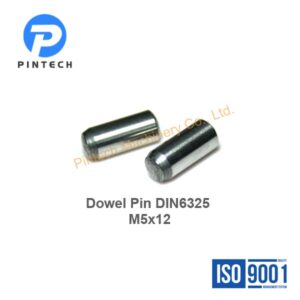
Dowel pins are essentially cylindrical alloy rods that are primarily used for connecting parts in large machinery that require precise stacking. In order for these components to perform their tasks effectively, their structure and strength are critical. That’s why dowel pins are manufactured to specifications.
A dowel pin is essentially a cylindrical alloy rod used primarily for connecting parts in large machinery that require precise fit. In order for these components to perform their tasks effectively, their structure and strength are critical. This is why the American Society of Mechanical Engineers has standardized manufacturing specifications for dowel pins as follows:
Material
Typically, dowel pins are made from steel alloys that contain small amounts of sulfur and phosphorous, 0.04% and 0.05% to be exact. However, because pins are used in several industries—including water treatment, pump manufacturing, steel fabrication, and railroad construction—they can also be used in other materials such as brass, 18-8 and 316 stainless steel, aluminum, and titanium.
Design
Regardless of the metal alloy used, the pin needs to go through a hardening process called austenitization. This procedure is usually used on iron-based metals and means subjecting them to excessively high temperatures, which transform the crystal structure to austenite (gamma-iron).
Hardness factor
The effect of the austenitizing process is to achieve a certain level of hardness on the inside and outside of the dowel. In short, according to ASME standards, a dowel is properly manufactured if it has a shell hardness of at least 60 and a core with a hardness level between 47 and 58. Hardness is usually measured on the Rockwell C scale, a system used to calculate the indentation of steel using a pointed diamond cone. Naturally, harder steel alloys will have less indentation than softer steel alloys.
Crown end specification
The crowned or rounded ends of the dowels are obtained through a process called chamfering, which removes sharp edges and flattens the entire surface to make them easier to work with. Here, the manufacturer needs to ensure that the height and radius of the crown comply with ASME’s specifications. For example, a 1/8″ dowel must have a crown height of 0.041″ and a crown radius of 0.016″.
Chamfer end measurement
The chamfered or beveled end of a dowel must have an angle between 4 and 16 degrees to be measured as suitable for use. Slopes are usually specified by minimum and maximum point diameters. Remember, because dowels come in a variety of sizes, from 1/8″ to 1″.
When selecting dowels, you should pay attention to these data, because the diameter of the final hole and the pin must match exactly. If the pins are too small, they will slip out of the holes, and larger pins won’t fit in at all. As a side note, it is recommended to use a pin that is longer than the depth of the hole, the remainder is what is commonly referred to as “engagement”.