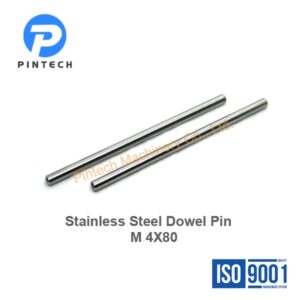
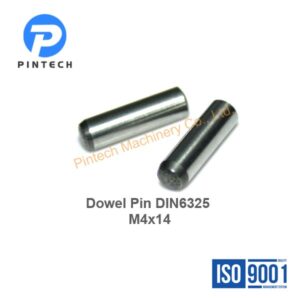
Fastening pins and alignment dowels can be easily press-fit into metal or plastic to quicken and optimize part assembly.
Both the pins and dowels are cost-effective, install easily and have a decades-long record of success. No wonder they are increasingly popular among manufacturers in a wide range of industries, most notably automotive, medical devices and recreation.
Extensive Selection
Many different types of pins are used for assembly, and they can be solid or hollow, symmetric or asymmetric in shape. Solid symmetric pins include dowel, grooved, knurled, barbed, and ferrol. Asymmetric pins, commonly known as studs, have flat or round heads.
Hollow symmetric pins are slotted with a coiled spring. All dowels are hollow and symmetric, having either a split or seamless body.
Pins and dowels have diameters ranging from 0.03125 to 1.5 inches and lengths up to 6 inches. They are typically composed of low-carbon or stainless steel, different alloys, aluminum, brass, or titanium. The finishes are passivated, nonpassivated, and black oxide.
The dowel pin is a smooth cylinder of metal, which may be chamfered at each end to assist entry. This pin is often hardened and machined to precise fractional diameters and lengths, then utilized as a hinge, shaft, or pivot to locate or hold pieces together.
The dowel pin withstands the most shear force of any fastening pin. It is preferred for high-production assembly because it requires no extra fastening hardware for insertion or secondary operations.
A Grooved pin is great for permanent joints or those that require pivoting or rotation, as well as for part location. Many manufacturers prefer using groove pins to screws in assemblies that are regularly exposed to high vibration.
Unlike a straight dowel pin, where retention is provided by the uniform interference between the pin and hole, knurled pins are designed to cut into the host components. However, neither knurled nor grooved pins require the tight tolerances needed by precision solid dowel pins.
Straightforward Installation
For pins and dowels, press-fit is the standard installation method. Installation may be permanent or temporary, and is a simple process that is typically done with a benchtop manual, pneumatic or hydraulic press.
In general, solid pins should be 0.0002 inch broader than the nominal hole diameter. For example, a 0.25-inch standard hole will accept a dowel with a diameter ranging from 0.2501 to 0.2503. Oversized pins are typically used to fit into worn holes (for pin replacement) and have a diameter 0.001 inch larger than the nominal diameter.
Precision solid dowels require a precisely drilled and reamed hole prior to being press-fit into place. In contrast, holes for coiled spring and slotted pins only have to be drilled, resulting in lower preparation costs.
Different Types Of Dowel Pins
Pintech offers a range of dowel pins to accommodate different application requirements.
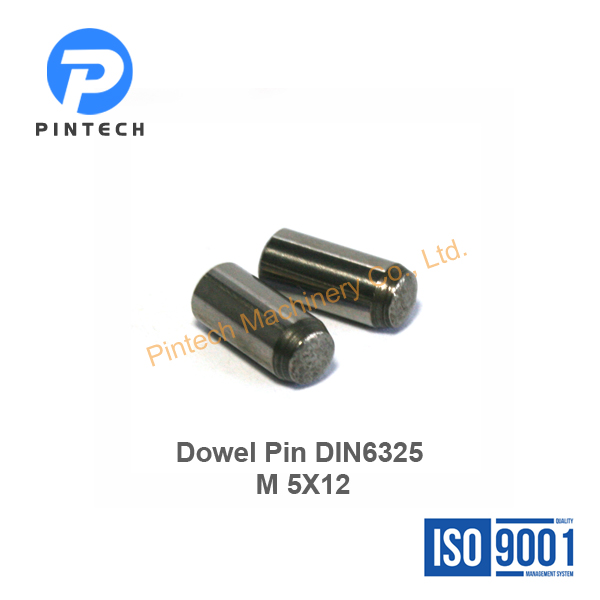
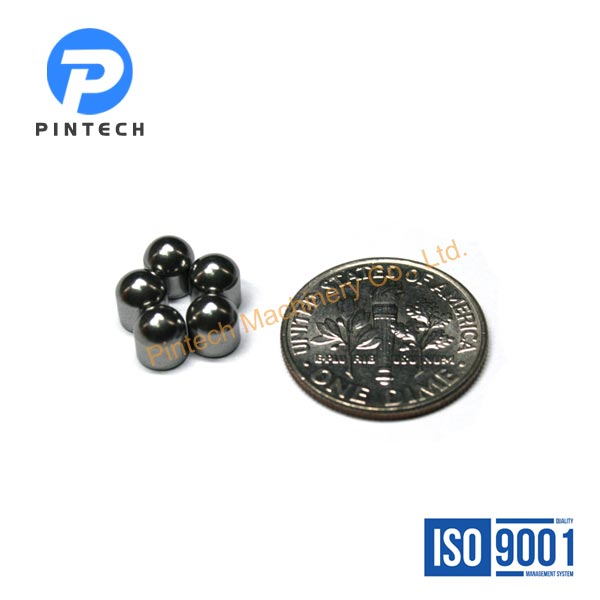


Standard dimensions for dowel pins, DIN6325 and ISO8734, are available from stock, other sizes are available on request.