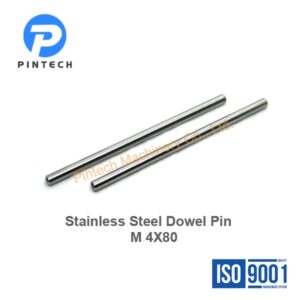
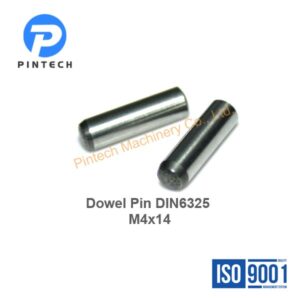
Dowel pins are common industrial fasteners capable of joining two or more parts together. Although dowels may be made of wood, metal, or plastic, they are typically short cylindrical rods that can be tapered, slotted, or grooved. Since dowels are often used to maintain the precise alignment of machine parts or serve as positioning guides, it is useful to have a basic understanding of these types of fasteners and the various types available in the market.
Unlike many other components, dowels are completely free of any driving or moving elements. Instead, they rely on their high coefficient of friction to stay securely within the press-fit, pre-drilled holes into which they are inserted. Additionally, adhesive can be applied for further security. Dowels also present a unified appearance in their components due to the absence of certain elements, making them an ideal solution for furniture and other aesthetically oriented applications.
To ensure that all assembled parts stay together without the need for additional fasteners, the dowels selected must be rigid when installed. For the strongest fit, the hole that the dowel fits into must be the exact same size or slightly smaller than the dowel itself. Since dowels have established breaking strengths that indicate when double shear has occurred, it is important to identify any potential operating loads before making a purchasing decision.
The manufacturing process for dowels may vary depending on the material and design of the fastener involved. For example, wooden dowels can be produced using the same rolling mills as other cylindrical wooden products, but they are smaller in structure and size. Most wooden dowels are made of hardwood and can be planed or grooved as desired.
For metal dowels, the melting and casting process follows a standard procedure that begins with the melting and refining of raw materials and ends with various quality checks and inspections. Depending on the application, a variety of materials are available, with common choices including aluminum, brass, stainless steel, steel, and titanium. Additionally, plastic pins are often manufactured through plastic injection molding.
In addition to determining which material is best, it is important to consider the lead size in terms of outer diameter and length. The outer diameter refers to the measurement of the edge that determines the width, while length is measured across the longest cross-section of the component.