Special end designs or special dimension on non‑standard parts require a milling process. Milling is a multi‑point cutting process used to remove material from the face or periphery of a workpiece by a rotating cutting tool.
When the workpiece is moved in relation to the cutting tool on a fixture, the cutting tool rotates quickly. To minimize the time required to position or lock workpieces to the machine table, a fixture is a work-holding device made expressly to hold one or more workpieces firmly in place. The process of milling is significantly more sophisticated than it looks, and it may be aggressive and demanding. Fixtures must be rigid during the process because even minute movements can have an impact on the outcome.
Computer Numerical Control (CNC) technology directly controls the workpiece’s travel route and the spindle height for the rotating tool. The spinning tool can be an insert or a solid component. This high-speed milling technique is cost-effective, with tool life and wear being critical factors Instead of using a single large end-mill, inserts allow for the installation and reuse of small teeth on three or more separate corners.
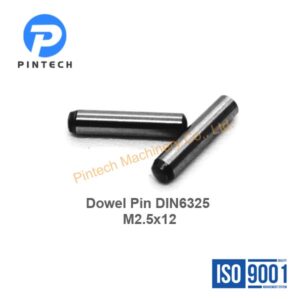
Milling is used to drill and tap holes, insert steps or cuts in a part, and alter the tolerances (dimensions) of the product. After an operation, parts can be deburred in the machine by switching out the tools. Modifying the ends-such as the Form A spherical ends on dowel pins-can also be done by milling. Our mills can be used for any procedure that involves a spinning cutter, and the combinations of inserts, tool holders, and tooling are nearly infinite.
Milling generates heat. When you remove cold-finished material from a part’s exterior, the stresses reintroduced into the steel during that process can affect the part. This may cause the part to bend or warp. When modifying tolerances and dimensions through milling, warpage may become an issue. One of two approaches can be used to counteract these distortions: the first is to reduce stress in the material before milling. If this technique is applied, the pieces might need to be heat treated after milling in order to restore the appropriate hardness of the material. The second technique involves controlling the quantity of material removed from each side of the part by milling it on both sides.
On carbon steel parts, the maximum material removal typically allows for 0.125″ of material removal. It is necessary to mill the part on both sides in order to make larger tolerance adjustments. Because stainless steel has more stresses than carbon steel, it is typically machined on both sides.
Milling maintains a minimum tolerance of 0.003″. For tighter tolerances, use grinding as a secondary operation. However, grinding is costly and time-consuming.
At Pintech Machinery
Pintech Machinery, with its advanced equipment, craftsmanship, comprehensive support, and professional service, specializes in the production of needle rollers, cylindrical rollers, dowel pins and universal joints.
Offering customization services, we have developed thousands of customized products for our clients over the years. We regularly upgrade our production equipment and processes to meet the evolving needs of our customers, fostering mutual growth.Welcome to contact us for more information!